Run down houses for sale in Toronto can be worth buying, but only when the numbers work after repairs, taxes, carrying costs, financing, and a real profit margin. A tired house is not automatically a deal. In this city, ugly can still be overpriced.
The investor edge comes from buying the spread, not buying the story. That means estimating the after repair value, subtracting renovation costs, land transfer taxes, closing costs, holding costs, selling costs, a risk buffer, and your required profit. If the remaining number is below the seller’s price, you do not have a deal. You have a renovation project with hope attached.
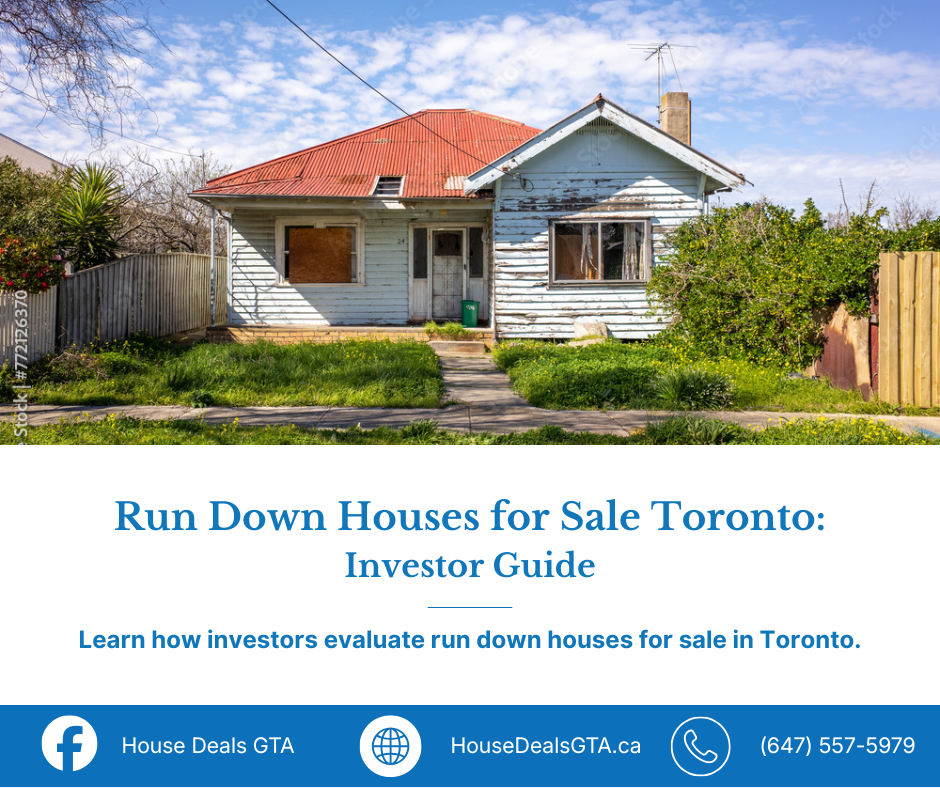
The best opportunities usually come from properties where the story is more complicated than the listing photos show: estate situations, vacant houses, deferred maintenance, old interiors, water damage, failed listings, or sellers who value certainty over squeezing every last dollar. Retail buyers may still be interested in those properties, but they are usually looking at them through a different lens. Investors need to underwrite the spread, the repair scope, the timeline, and the exit before getting excited. That is where House Deals GTA’s off-market deal flow can give investors an advantage, because by the time a run down house hits the open market, more buyers may already be chasing the same opportunity.
What Makes a Run Down Toronto House Investor-Grade?
A run down house for sale in Toronto is not investor-grade just because it needs work. Peeling paint and old flooring are cosmetic. Foundation movement, knob-and-tube wiring, buried oil tanks, structural framing changes, sewer issues, environmental concerns, and zoning limitations are different animals.
The question is not, can it be fixed? Almost everything can be fixed at the right price. The better question is: can it be bought at a price where the fix still leaves enough profit for the risk?
Investor-grade rundown houses usually have at least one of these characteristics:
- A purchase price that is meaningfully below renovated comparable sales
- A repair scope that can be estimated with reasonable confidence
- A layout, lot, or location that supports resale demand after renovation
- A seller situation where speed, certainty, or privacy matters
- A clear exit strategy before you waive conditions
That last point matters. Toronto punishes vague plans.
The Formula Before You Fall in Love With the Property
Use this simplified investor formula before spending emotional energy on a property:
Maximum Purchase Price = ARV minus renovation costs minus buying costs minus holding costs minus selling costs minus risk buffer minus target profit
ARV means after repair value. It is the likely resale value after the house is renovated to the standard buyers expect in that specific neighbourhood. Not the nicest sale you found online. Not the highest detached comp in a different school catchment. The real number.
Here is a basic Toronto example.
A run down semi-detached house has a realistic ARV of $1,150,000 based on renovated nearby sales. Your contractor estimates $180,000 in renovations. You budget $22,950 for Ontario and Toronto land transfer taxes at a $750,000 purchase price, plus $6,000 for legal, inspection, and closing items. You estimate $65,000 for financing, insurance, utilities, property tax, staging, resale commission, and four to six months of holding time. You want at least $100,000 in gross profit because this is not a paint-and-carpet job.
The math looks like this:
$1,150,000 minus $180,000 minus $22,950 minus $6,000 minus $65,000 minus $100,000 = $776,050
That means a purchase around $750,000 may be worth a serious look. A purchase at $850,000 probably leaves too little room unless your ARV is stronger, your renovation scope is lighter, or your exit strategy is different.
This is why investors cannot underwrite run down homes for sale in Toronto using gut feel. The deal either survives the math or it does not.
The Toronto Cost Stack Is Real
Toronto has a cost stack that investors need to respect. Ontario land transfer tax applies on purchases, and Toronto also has a municipal land transfer tax. Both use graduated brackets, so your buying cost rises as the purchase price rises. On higher-value Toronto properties, those closing costs can change the deal quickly.
Permits are another major swing factor. Construction, demolition, additions, and material alterations usually require proper permits. Open permits can also complicate future transactions or future building permit applications. Investors should not treat permit risk as paperwork. It can affect timeline, resale confidence, and holding costs.
Vacancy can carry its own risk too. Toronto has a Vacant Home Tax for applicable vacant residential properties. If you are buying a vacant or long-held property, confirm the status, declarations, timing, exemptions, and closing adjustments with your lawyer.
None of this means run down houses are bad investments. It means the discount has to be real. A $70,000 discount on a property that needs $180,000 in work is not a bargain. It is a trap with fresh photos.
Where Investors Usually Misread Rundown Houses
The first mistake is using retail renovation thinking. Retail buyers ask, what would I change? Investors ask, what must be changed to hit the exit number?
Those are different questions. A flipper does not get paid for personal taste. A landlord does not get paid for over-improving beyond rent demand. A BRRRR investor does not get paid for a renovation that looks impressive but fails appraisal or cash flow.
The second mistake is underestimating time. A house that needs structural work, permits, trades, inspections, and resale prep will not move like a simple cosmetic flip. Every extra month adds financing, insurance, utilities, taxes, and opportunity cost.
The third mistake is assuming every ugly property has upside. Sometimes the property is ugly because it has been ignored. Sometimes it is ugly because the numbers never worked for the last person either.
That is the difference investors have to catch early.
What to Look at During the First Walkthrough
Before you spend money on deeper due diligence, train your eye around the expensive items. Cosmetics come later.
Start with the basement. Look for moisture, efflorescence, uneven floors, patched foundation walls, low ceiling height, old mechanicals, and signs of amateur work. Then look up. Roofline sag, water staining, poor attic ventilation, and structural alterations can change the budget quickly.
Check the electrical panel, visible wiring, plumbing type, furnace age, windows, roof, exterior grading, masonry, and drainage. A great interior renovation cannot fix a bad lot problem cheaply.
For investors evaluating run down houses for sale in Toronto, the walkthrough should produce one of three decisions: pass quickly, investigate further, or make a disciplined offer. The worst outcome is staying interested in a weak deal because you already spent too much time on it.
Off-Market Matters More With Rundown Houses
Public listings can still produce deals, but investors should be honest about competition. Once a visibly distressed Toronto house is on MLS, every flipper, contractor, builder, and investor with saved searches can see it. That attention can compress the spread.
Off-market sourcing changes the game. When a seller is dealing with an estate property, vacancy, deferred maintenance, or financial pressure, the property may never need to become a polished retail listing. That is the lane House Deals GTA works in.
House Deals GTA sources off-market and below-market opportunities across the GTA and Ontario, then packages them for investors who know how to evaluate numbers. Investors can also review House Deals GTA’s Toronto investment properties for sale to see the types of discounted opportunities that come through the pipeline. The value is access to deal flow before the broader market has fully priced the opportunity.
For a deeper look at this sourcing angle, investors can also read House Deals GTA’s breakdown on how to find off-market properties in Ontario. The key point is simple: off-market does not automatically mean profitable, but it can give disciplined buyers a better shot at the spread when the numbers are verified properly.
A Better Way to Underwrite the Next Deal
When you look at the next rundown house for sale in Toronto, force yourself to answer five questions before you chase it:
What is the true ARV based on tight nearby comps?
What is the repair budget with a contingency, not the best-case number?
What permits, zoning, or inspection issues could affect the timeline?
What is my exit: flip, rental, BRRRR, severance, garden suite, or hold?
What is the maximum price I can pay and still be paid properly for the risk?
The final question is the one that keeps investors alive. Not every run down house deserves an offer. Not every discount is deep enough. Not every ugly property has hidden upside.
But when the purchase price, renovation scope, exit strategy, and timing line up, run down houses can be some of the best acquisition opportunities in Toronto. They are messy. They require discipline. They are not for investors who want clean paperwork and perfect walls.
That is also why they can work.
Work With a Deal Source That Knows the Investor Process
Buying a run down house in Toronto is not just about finding a property that needs work. It is about knowing what to pay, what to avoid, how to read the spread, and when to move before another investor gets the opportunity. That is where House Deals GTA can help. Our team works with investors across the GTA and Ontario who are looking for off-market wholesale properties, fixer uppers, distressed houses, rental opportunities, and renovation plays that are not always available through traditional listings.
Whether you are sharpening your first flip strategy or adding another property to an established portfolio, we are here to help you evaluate opportunities with clearer numbers, better context, and a smoother acquisition process. Join the House Deals GTA Preferred Buyers list or call (647) 557-5979 to tell us what you are looking for, and we will be happy to help you every step of the way.